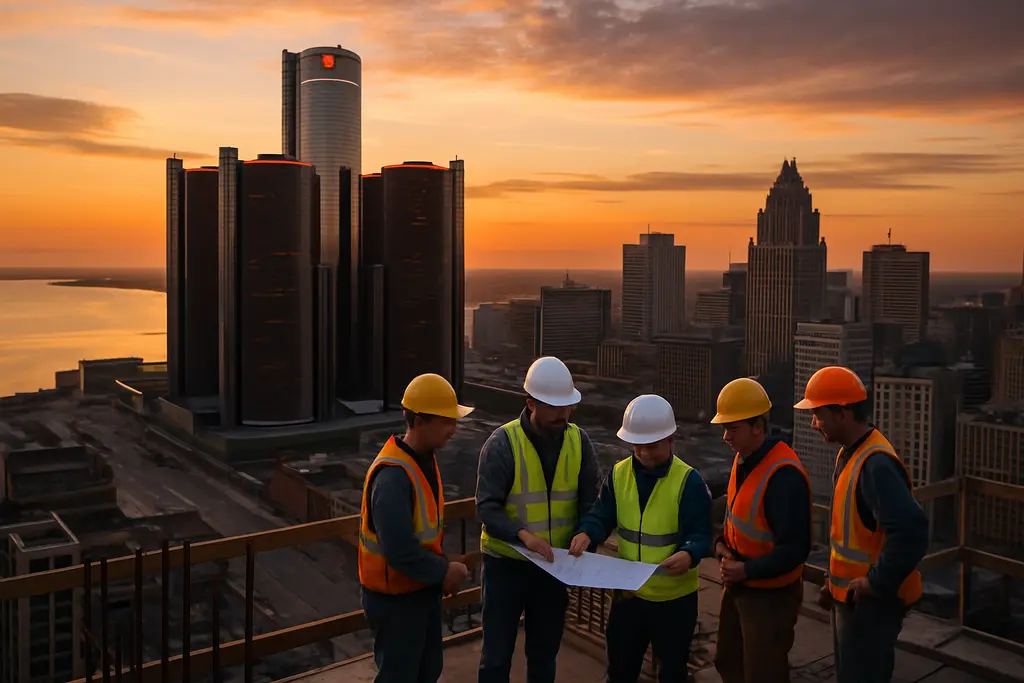
Detroit RenCen Redevelopment Raises Housing Stakes
Detroit RenCen Redevelopment moved from broad civic idea to formal public review in 2026, with Bedrock and General Motors proposing a $2.2 billion remake of the Renaissance Center complex and nearby east riverfront land. As of Oct. 6, 2026, the plan remained significant for Detroit residents because it tied a major riverfront reuse effort to affordable housing, job creation, public incentives and the city’s Community Benefits Ordinance process.
What Detroit RenCen Redevelopment Proposes
The proposal described in mid-September 2026 called for redeveloping the RenCen complex and adjacent east riverfront property. The project area spans more than 40 acres of underused land, including the Renaissance Center and nearby surface lots, according to the City of Detroit’s current Community Benefits Ordinance engagement page for the Renaissance Center and East Riverfront Projects.
The physical plan, as described in the research record, would preserve or redevelop three of the five original towers. The two towers closest to the Detroit River would be demolished under the proposal, with the stated aim of opening more riverfront access and strengthening the connection between downtown and the river. That change is not only architectural. It would affect how workers, residents and visitors move through one of Detroit’s most visible downtown sites.
Detroit RenCen Redevelopment Timeline
Project documents referenced in late September 2026 placed full completion in 2038, with stabilization of residential, office and hotel uses expected around 2036. Those dates show the scale of the proposal. This is not a short-term construction project with a single opening date; it is a long redevelopment period that could shape public space, housing supply and job access for more than a decade.
Because the timeline stretches across several city budget cycles and market conditions, residents and officials will likely need repeated checkpoints. Public commitments made early in a project can become harder to track if responsibilities shift or schedules change. For that reason, clear reporting on housing, hiring and infrastructure benchmarks will matter as much as the initial design concept.
Riverfront Access And Tower Changes
The RenCen has long stood as a dominant downtown structure, but the proposal focuses on land around it as much as the towers themselves. The stated goal of better connecting downtown to the Detroit River raises civic questions about access. If surface lots become housing, open space or mixed-use development, the result could change daily patterns for office workers, residents of nearby neighborhoods and people using the riverfront.
The proposal also raises practical questions. Demolition of two towers would require coordination around safety, traffic, riverfront movement and business access. Those details were not fully resolved in the research record. What is clear is that the city’s review process has treated the project as large enough to require formal community benefits engagement.
Affordable Housing And Public Incentives
The housing portion of the proposal called for about 934 apartment units, with roughly 250 slated as affordable units. For Detroit RenCen Redevelopment, that affordable housing figure is central to the public discussion because the project is also seeking public support. The research record says the proposal seeks $300 million through Michigan’s Transformational Brownfield Program as part of about $473 million in public incentives. It also says the project is claimed to generate about $300 million in new city revenue over 30 years.
Those figures put two public questions side by side. First, how much affordability will Detroit secure in exchange for public participation? Second, how will the city define and monitor those affordable units over time? The research notes did not specify the income limits, lease terms or compliance period for the RenCen affordable units. Without those details, residents cannot yet fully judge who would be served or for how long.
Housing Units In The Plan
The 250 affordable units would represent a little more than one-quarter of the roughly 934 apartments described in the proposal. That is a meaningful share, but the public impact depends on affordability levels. A unit affordable to a household earning 80 percent of area median income serves a different income range than a unit restricted at 60 percent, 50 percent or 30 percent. The research record only supports the number of units slated as affordable, not the income tiers.
Detroit residents tracking the proposal may want to watch for whether affordable units are spread across buildings, whether they include family-sized apartments, and whether they remain restricted beyond an initial incentive period. Those policy details are often where a housing commitment becomes either broad public benefit or a narrower set-aside.
Citywide Housing Context
Detroit’s affordable housing discussion is not limited to one riverfront project. A Michigan State Housing Development Authority report through Q1 2025 cited 1,681 new affordable housing units developed for households at or below 60 percent of area median income, bringing restricted stock to 25,093 units, with another 992 units under construction, according to the MSHDA housing report.
That context does not answer whether the RenCen proposal provides enough affordable housing. It does show why the number, depth and duration of restrictions matter. A high-profile project can add units, but it can also influence expectations for future downtown and riverfront redevelopment proposals. If public incentives are approved, local housing advocates and residents will likely measure the project against its final affordability commitments rather than the early unit count alone.
Jobs, Construction Work And Community Benefits
The job estimates tied to Detroit RenCen Redevelopment were also large: 2,700 full-time jobs after completion and 8,000 construction jobs during the build phase. Those numbers signal why workforce access is part of the community discussion. Construction jobs may last for years, while permanent jobs would depend on the mix of office, hotel, residential, retail and public-space uses that survive the approval and financing process.
For workers, the key issue is not only the total count. It is whether Detroit residents can reach, qualify for and hold those jobs. Public review can examine hiring goals, apprenticeship pathways, small-business participation and transportation access. The research record did not include wage levels, job classifications or local hiring requirements, so those details remain uncertain as of Oct. 6, 2026.
Construction And Permanent Work
Construction employment would be tied to the project’s long buildout, with demand changing by phase. Demolition, site preparation, utility work, building rehabilitation and new construction would likely involve different trades at different times. The research record supports the 8,000 construction-job estimate, but not the distribution of those jobs by year, trade or contractor.
Permanent jobs would depend on how much office, hotel, retail and service activity is active once the project stabilizes. The 2,700 full-time-job projection gives residents a point to track, but the city and development team would need to define what counts as a full-time job, where those jobs are located, and how job totals will be verified.
Community Benefits Process
The project entered Detroit’s Community Benefits Ordinance process in August 2026. The first Community Benefits Organization meeting was held Aug. 18, 2026, and another meeting took place Sept. 1, 2026, to elect advisory council members. The formal impact area covers about 4,600 residents, according to the research record, though some residents argued the defined area was narrower than the full reach of the project’s effects.
That concern is worth taking seriously in civic terms, while staying within what is verified. A project of this size can affect more than the residents living closest to the site. It can affect bus riders, riverfront users, downtown workers, nearby small businesses and residents watching how public incentives are used. The formal process gives a defined group a structured role, but public meetings, city documents and council review can still matter for a wider audience.
For readers following how public support for the project has been framed, One United Michigan previously covered how RenCen redevelopment funding entered public review. Regional business readers outside Detroit can also find related chamber updates on redevelopment efforts within the network through the Richland Area Chamber of Commerce.
Community Review And Resident Voice

Community review is where a large proposal becomes specific for residents. The City of Detroit’s CBO process gives the project a formal civic pathway, but the value of that process depends on the clarity of public information. Residents need plain answers on the number of affordable units, the income levels served, the length of affordability restrictions, hiring commitments, traffic changes and the use of public incentives.
The scale of the proposal also calls for careful tracking of claims. The public revenue projection, job estimates and housing promises should be measured against written agreements, not only presentations. That does not mean the project should be treated with suspicion by default. It means a public-private redevelopment of this size should be reviewed in a way that residents can follow over time.
What Residents Can Track
Residents and community groups can focus on a few practical questions as records develop:
- What income limits will apply to the roughly 250 affordable apartments, and how long will those restrictions last?
- How will the city verify the projected 2,700 full-time jobs and 8,000 construction jobs?
- Which public incentives are approved, and what public benefits are attached to each approval?
- How will riverfront access, construction impacts and transportation routes be managed during the buildout?
Those questions keep the discussion grounded in civic outcomes. The proposal’s design and skyline effects may draw attention, but the lasting community test will be whether the project delivers housing access, jobs and public space improvements that residents can see and use.
Detroit RenCen Redevelopment And Community Stakes
The proposal placed Detroit’s most recognizable riverfront complex at the center of several local priorities: housing supply, downtown reuse, job access and public accountability. As of Oct. 6, 2026, the plan had already moved through early community benefits meetings, but many details that matter to residents were still not fully defined in the research record.
The most useful way to follow the project is to separate what has been proposed from what has been approved, and what has been promised from what has been written into enforceable terms. The proposal’s affordable housing count, job projections and riverfront access goals give Detroit residents a starting point. The next civic value will come from clear documents, public reporting and review that keeps community benefits visible through a long development schedule.