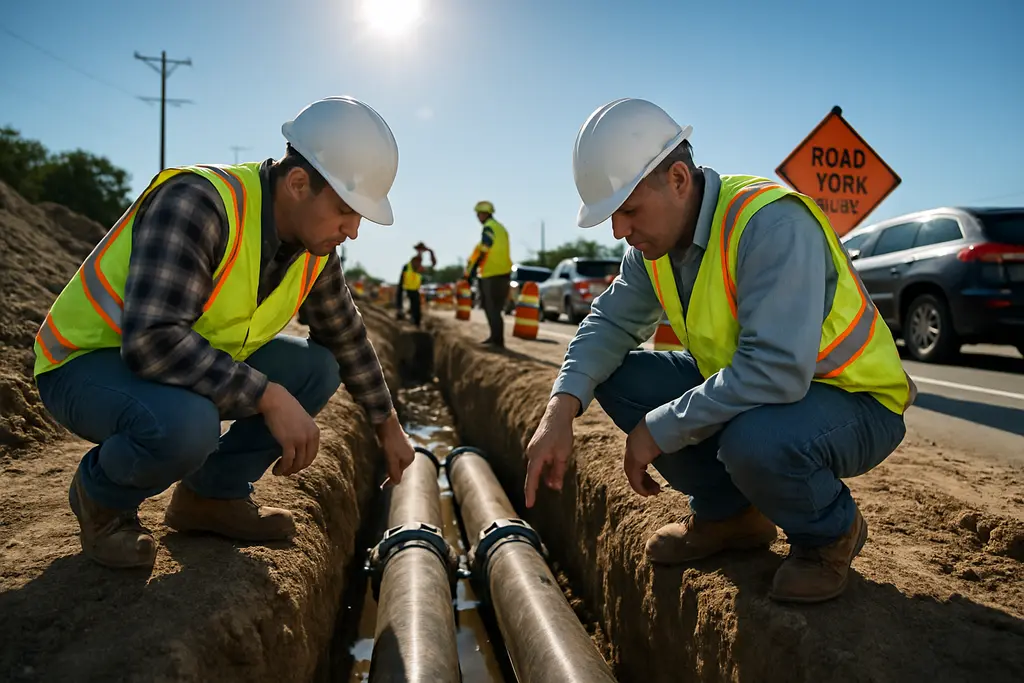
Water Main Replacement on 14 Mile: $81M Impact
The $81 million water main replacement planned along 14 Mile Road is set to bring a long construction period to Novi, Farmington Hills and nearby Oakland County communities, but it also responds to a series of pipe failures that have disrupted residents, schools, businesses and emergency access. The Great Lakes Water Authority announced the project on July 21, 2026, describing work on a failing 48-inch prestressed concrete cylinder pipe beneath 14 Mile Road and related upgrades east of Farmington Road, according to a ClickOnDetroit report.
What The Water Main Replacement Covers
GLWA’s plan is split into two main parts across a six-mile stretch tied to the 14 Mile Road corridor. Phase One is scheduled to replace three miles of existing 48-inch prestressed concrete cylinder pipe, often called PCCP, with a 54-inch steel pipe from Haggerty Road to Farmington Road. Phase Two is set to address a separate three-mile section from Farmington Road east to GLWA’s Franklin Pump Station, with inspections, targeted repairs and real-time monitoring technology.
For residents, the practical change is that a pipe segment with repeated failures is being removed and replaced in the western portion of the project area, while the eastern portion is being watched and reinforced rather than fully replaced. That distinction matters because it helps explain why construction impacts may vary block by block and why the project is not simply one continuous open trench from end to end.
Route And Pipe Work
The most direct construction impact will be along 14 Mile Road, a corridor that carries local trips between Novi, Farmington Hills and surrounding communities. GLWA has said the first phase will begin with the Haggerty Road-to-Farmington Road segment. The project is scheduled to start in November 2026 and continue into early 2028, with the replacement phase first and the second phase following.
The pipe change itself is substantial. GLWA plans to replace the 48-inch PCCP with a 54-inch steel pipe in Phase One. That is not just a size change; it is a material change from the pipe type that has failed several times in recent years. The authority has said the remaining segment to the east will receive inspection, repair and acoustic fiber-optic monitoring, rather than the full steel replacement now planned for the western section.
Why The Water Main Replacement Is Moving Forward
The reason for the water main replacement is clear in GLWA’s account of the line’s recent performance. The authority has reported four major breaks in the affected pipe over the past seven years. Those failures caused flooding, water outages and disruption for homes, schools, businesses and first responders. The most recent ruptures cited in the project record occurred in September 2025 and on March 7, 2026.
The March 7, 2026 break was especially disruptive for Novi. Research notes from the City of Novi’s public materials say the 48-inch main broke around 4:30 a.m. at 14 Mile Road and Verona in Farmington Hills. That incident flooded six homes, stranded motorists, required some evacuations and left Novi without water for roughly 26 hours. For many households and businesses, the project is being judged against that recent experience, not against a general concern about old infrastructure.
Traffic And Service Effects During Water Main Replacement
Traffic disruption is the main day-to-day issue residents can expect once field work begins. GLWA and the Road Commission for Oakland County are still finalizing traffic plans, and public open houses are expected before construction. Because the work is tied to 14 Mile Road, detours, lane restrictions or access changes could affect school routes, business deliveries, emergency response planning and daily commuting patterns.
During water main replacement work, residents should watch for specific construction notices rather than rely on general project timing. The overall schedule runs from November 2026 into early 2028, but the effect on a particular driveway, intersection or business entrance may depend on phasing, weather, utility coordination and road restoration work.
Construction Schedule And Road Planning
Local governments and road agencies will have a direct stake in how construction is staged. The 14 Mile Road corridor connects several municipal boundaries and service areas, so clear notices will be needed for residents who may live in one city, work in another and use the same road segment for daily travel. A project of this length also overlaps with winter weather, school calendars and business delivery cycles.
For readers tracking similar municipal infrastructure pressures in southeast Michigan, our coverage of Livonia infrastructure updates offers another example of how water, road and utility work can affect residents well beyond the construction zone.
Water Service And Emergency Concerns
GLWA has said household water service should see little to no impact during construction because the system is expected to use redundancy and alternate flow paths, according to Patch coverage. That assurance will be important for residents who remember the March 2026 outage, especially in Novi, where the disruption lasted about 26 hours.
Still, “little to no impact” is not the same as no need for preparation. Schools, health care offices, restaurants, retailers and first responders may want to follow GLWA and local city notices closely once final traffic and service plans are released. The most useful information for residents will be direct dates, affected blocks, detour maps and any temporary access instructions.
Costs, Monitoring And Public Accountability

The $81 million price tag covers more than a basic pipe swap. Phase Two includes an acoustic fiber-optic monitoring system designed to detect leaks and wire breaks in real time. Those conditions can signal deterioration in PCCP. GLWA has said this kind of monitoring is meant to help identify problems before they become major leaks or ruptures.
The monitoring issue is central because earlier inspections in 2019 and 2021 reportedly found no defects, yet the pipe later failed. The pipe was installed in the early 1970s with an expected lifespan of about 100 years, but GLWA’s recent project explanation points to faster degradation than anticipated. Possible causes cited in research notes include internal wire or mortar corrosion or other structural issues. The public interest now is whether the new work and monitoring tools reduce the risk of another sudden break.
What The $81 Million Plan Buys
For Novi and Farmington Hills, the water main replacement is both a utility project and a public confidence test. Residents have already seen the cost of failure through flooded homes, stranded motorists and a long outage. The project’s value will be measured in fewer disruptions, better detection and a clearer maintenance record for a pipe system that serves more than one community.
Business owners along and near the corridor will be watching construction access, customer traffic and delivery routes. Local chambers and business associations often become useful points of contact during long public works projects. Readers interested in business support networks within the state will find helpful resources through the Richland Area Chamber of Commerce.
Lessons From Earlier Work
GLWA completed related work in May 2026 on a separate project that replaced more than one mile of PCCP, renewed another short segment with carbon fiber reinforced polymer and installed acoustic fiber-optic monitoring from just west of M-5 to the Wixom Booster Station. Research notes say that $12.8 million project was completed on time and within budget, while road restoration remained underway in late June 2026.
That earlier work gives residents one benchmark, but the 14 Mile Road project is larger and will last longer. The most relevant civic questions are practical: when will each segment be affected, how will local traffic be routed, how will access to homes and businesses be maintained, and how will GLWA report progress if field conditions change?
Novi And Farmington Hills Water Main Project
The water main replacement is scheduled because repeated failures showed that the 14 Mile Road pipe could not be treated as a routine aging asset. The project will bring construction inconvenience, especially for drivers, but GLWA’s stated plan is to maintain water service for homes and businesses through system redundancy and alternate flow paths.
Residents in Novi, Farmington Hills and nearby Oakland County communities should expect the next civic step to come through finalized traffic plans and public open houses before construction starts in November 2026. The most useful public updates will be those that identify exact work zones, detours, service expectations and contact points for residents and businesses affected by the work.