Bass Lake Improvements Hearing Recap for Summit
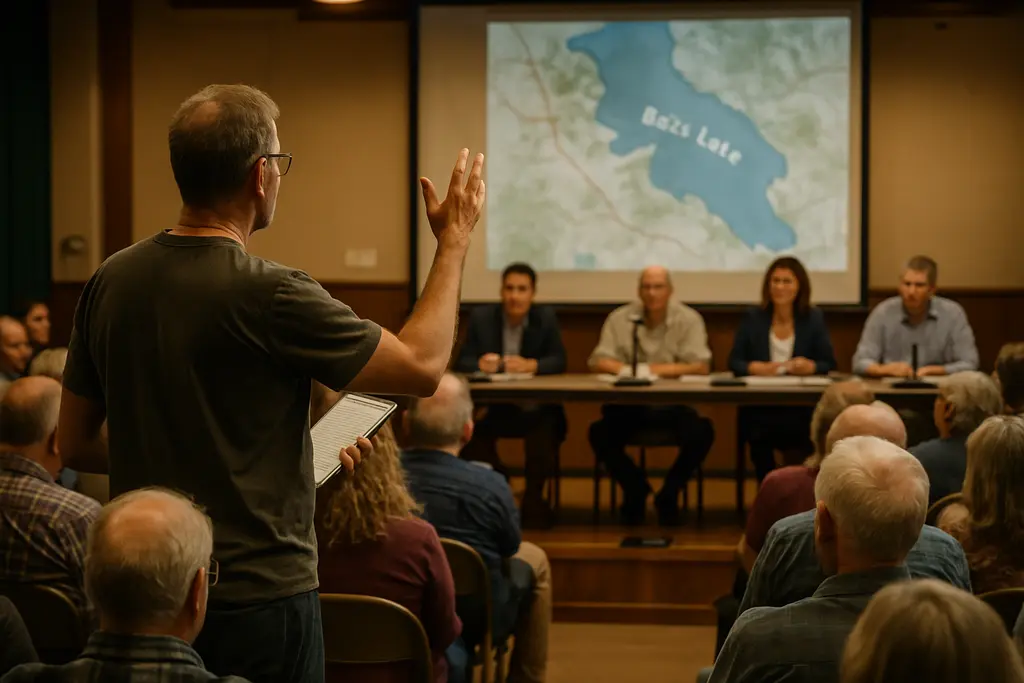
Bass Lake improvements were the focus of a public hearing held on August 6, 2026, at 7:00 p.m. at Summit Township Hall, 4879 W. Deren Road in Ludington. Because that date has passed, the useful question for residents now is not how to attend, but what the hearing was designed to cover, what records should be checked next, and how any proposed assessment could affect property owners around the lake.
The hearing was tied to practicability and assessment requirements for proposed inland lake work. The supplied research says public notice was posted on July 17, 2026, for the August 6 hearing, and that notices were required to be published at least twice before the meeting. Residents checking local postings, board materials, or later meeting records should start with Summit Township, the local government source connected to the hearing location and public notice information.
What Bass Lake Improvements Hearing Covered
Bass Lake Improvements Reports And Public Review
The August 6 hearing was structured around public review of engineering and economic reports. Under Michigan’s inland lake improvement process, a hearing must give community members, including affected property owners, a chance to review and comment on reports before a lake improvement board decides whether a proposed project is practicable. The state law governing that process is Part 309 of Michigan’s Natural Resources and Environmental Protection Act, which covers inland lake improvements and related procedures through Michigan’s inland waters statute.
The reports described in the research were expected to address engineering feasibility, economic impacts, estimated project costs, effects on local tax structures, and relevant right-of-way or groundwater conditions. That means the hearing was not limited to whether lake treatment sounded helpful in general. It was meant to test whether the proposed plan could be carried out, whether costs could be assigned through an assessment district, and whether the approach made sense for the lake and the property owners expected to pay.
For residents who did not attend, the most useful follow-up is to look for the hearing record, any board minutes, and any revised project documents made after August 6. The research provided for this article does not include a post-hearing determination, so this recap does not state whether the Bass Lake Improvement Board approved, rejected, or revised the plan after public comment.
Lake Conditions Raised In The Background Materials
The supplied research says the Bass Lake Improvement Board had previously contracted with LakeScan™ to monitor lake conditions. The 2023 monitoring summary described lake conditions as generally good, with plant community biodiversity recovering, while also identifying isolated cyanotoxin concerns near shorelines. The research also identifies invasive plants, including ebrida watermilfoil and curly-leaf pondweed, as management concerns targeted for suppression through selective herbicide applications.
Those details matter because the hearing was not just about one treatment method. It sat at the intersection of lake ecology, public spending, and local property obligations. The research says severe algae bloom concerns were connected in part to high water levels in 2019, when reduced light penetration affected bottom-growing plant communities. The project discussion was aimed at preventing repeat problems by supporting beneficial benthic plant growth while managing invasive species.
How Part 309 Shapes The Local Decision
What Practicability Means Under State Law
Part 309 requires a lake improvement board to decide whether a proposed project is practicable. In the context supplied for the August 6 hearing, that review includes technical feasibility, environmental effect, cost effectiveness, and effects on property owners. The board’s task is not simply to choose the most popular option. It must weigh whether the proposal can be done, whether the environmental tradeoffs are acceptable, and whether the public and private costs are justified by the expected benefit.
The research states that after public input, the board has up to 10 days following the hearing to make a determination unless more data is needed. Since the hearing took place on August 6, 2026, that 10-day window would have extended to August 16, 2026, if no extra information was required. Because the materials supplied here do not include records from after that date, residents should verify the board’s decision through official posted minutes, notices, or follow-up documents rather than relying on secondhand accounts.
Possible Outcomes From The Hearing
If the board found the proposal practicable, the next steps could include approving revised or new plans, setting the boundaries of a special assessment district, and establishing cost estimates and assessments. If the board found the proposal was not practicable, or if it needed more information, the process could have been delayed, changed, or sent back for more study.
- A formal decision on whether the proposed lake work was practicable.
- Possible approval or revision of the project plan and cost estimate.
- Possible determination of special assessment district boundaries.
- Possible scheduling of work such as herbicide applications, bottom sediment removal, or mechanical harvesting if later adopted.
Earlier local coverage also outlined the meeting context and assessment questions in a Bass Lake hearing preview. Readers interested in public-service coverage across Michigan might also find relevant regional reports via ITPR, a related site in the same network.
Assessment Issues For Property Owners

Costs, Boundaries, And Questions
For many residents, the central issue is whether their property falls inside a proposed special assessment district. The research says that if the project is approved, costs may be spread through such a district, meaning owners in the designated area around Bass Lake could face assessment charges tied to the project. The exact financial effect would depend on the final district boundaries, assessment roll, cost estimate, and allocation method approved through the process.
This is where the details matter. A property owner near the lake may want to know whether the assessment is based on frontage, parcel benefit, acreage, use, or another formula. The supplied research does not provide parcel-level assessment amounts or a final assessment roll. It also does not include the full engineering report or cost estimate. Residents should avoid assuming a cost until they review the official documents adopted or discussed after the August 6 hearing.
Practical questions raised by the research include whether alternatives to chemical treatment were considered, how environmental risks would be managed, how long-term maintenance would be funded, and how public lake benefits were weighed against private property costs. Those questions are especially relevant because the reports were expected to cover economic study findings as well as engineering feasibility.
- Is the property inside the proposed or final assessment district?
- What method was used to assign costs among affected parcels?
- Did the board adopt the original plan or revise it after public comment?
- What monitoring will be used to measure results after treatment or other work?
- How will future maintenance costs be handled if invasive plants return?
Bass Lake Improvements Next Civic Steps
What Residents Can Check Now
Since the August 6 public hearing has already taken place, the next civic step is records review. Residents should look for posted minutes from the Bass Lake Improvement Board, any resolution on practicability, updated engineering or economic reports, and any assessment district map or roll. If the board required more data, residents should look for a later meeting date or revised report schedule rather than assuming the process ended on the hearing night.
Bass Lake improvements remain a local governance issue because they connect water quality, lake access, property costs, and long-term maintenance. The supplied research shows that the scientific background includes recovering biodiversity, invasive plant pressure, and cyanobacteria concerns near shorelines. The civic record should show how the board weighed those conditions against project costs and public comments.
Residents who want to stay engaged should keep their review tied to official documents. The most reliable records will be meeting notices, minutes, adopted resolutions, engineering reports, economic studies, and assessment documents released by the township or improvement board. Until those post-hearing materials are available in the research record, the status of the final decision on Bass Lake improvements should be treated as unconfirmed here.